

How to Build Strong Local Business Partnerships That Last
Business owners (especially the local ones) often find themselves learning the hard way that great products don’t automatically create steady foot traffic or loyal repeat customers. The toughest part is building trust and visibility without burning time and budget on going it alone. Local business partnerships change the math by turning familiar faces into friendly allies, where shared audiences and word-of-mouth can travel faster than any flyer. With the right focus on small business networking, entrepreneur community engagement, and steady business relationship building, the community collaboration benefits show up as real momentum in the neighborhood.
Pick 7 Easy Partnership Plays to Try This Month
If local partnerships feel “big” and intimidating, good news: you can start tiny. Pick one or two plays below, aim for a simple win, and build the kind of neighborly trust that makes collaboration stick.
Join one local business network and show up twice: Find a chamber group, downtown association, or neighborhood merchant circle and commit to two meetings this month. Introduce yourself with one sentence about who you help and one sentence about what you’re looking to do together (examples: “gift guide swap,” “event co-host,” “referral exchange”). The magic isn’t the meeting, it’s the repeat sightings that turn you from “random business” into “known neighbor.”
Do a “two-intros” challenge at industry meetups: Go to one industry meetup and aim to make two helpful introductions for other people, not for yourself. Ask, “Who are you trying to meet locally?” then connect them to someone you know (or someone you just met). You become a connector fast, and connectors get remembered when partnership ideas pop up.
Co-sponsor a community event with a tiny, clear role: Pick one event, school fundraiser, street fair, sports team, library program, and offer a simple sponsorship package you can deliver in a week. Think: provide water, print flyers, donate small raffle items, or host a “check-in” table for one hour. When your role is concrete, the organizer can say yes quickly and you’ll meet other sponsors who already like community collaboration.
Run a two-week cross-promotion marketing swap: Choose one neighboring business with a similar audience and agree to swap visibility for 14 days. Keep it simple: one window sign, one social post, and one staff script (“If you liked this, you’ll love…”) with a tracked code or keyword. After two weeks, compare notes and decide whether to repeat, tweak, or try a new partner.
Start a partner referral program with one offer and one rule: Create one referral offer that’s easy to explain (example: “$10 off your first visit” or “free add-on with purchase”) and one rule (example: “new customers only”). Give partners a small stack of cards or a simple code, and check in weekly for a month. A case study showing $50,000 in new revenue from a referral approach is a nice reminder that referrals can be more than “nice”, they can be meaningful.
Team up on a neighborhood improvement project: Pick a block-level win like a quick litter cleanup, planting day, “fix-it” afternoon, or alley beautification. Invite two businesses and one community group, keep it to 60–90 minutes, and take a “before/after” photo for everyone to share. Community examples like the Jordan Rebuilding Block Party show how small, visible projects can rally neighbors and strengthen local pride.
Host a low-pressure “collab coffee” with a micro-agenda: Invite one potential partner for 20 minutes and bring a three-question agenda: What are you promoting this month? What’s one thing you wish customers understood? What’s a collaboration you’d actually enjoy? End by choosing a tiny test, one shared post, one referral swap, or one co-sponsored moment, so your “hello” turns into a real, trackable first step.
Pick one play, put a date on it, and keep it small enough to finish. Those little wins create a clear path from first handshake to a partnership you can grow on purpose.
Plan → Reach Out → Test → Review → Repeat
To keep those small wins coming, use this simple rhythm. It turns “we should collaborate sometime” into a steady loop of action, learning, and trust. The point is consistency, not complexity: one clear request, one tiny joint business initiative, then a quick check on what actually happened. If you track a couple of basics each cycle, you build momentum the way real community relationships do, by showing up and following through.
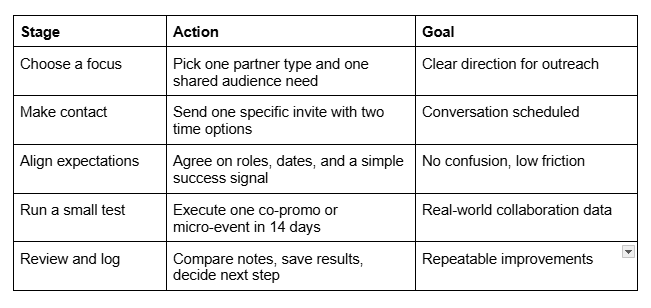
Think of it like a monthly loop: clarity creates easier coordination, the test creates proof, and the review keeps feelings from replacing facts. The habit of measuring progress echoes how longer programs get monitored over time, like a survey conducted in October 2024, collecting data for 2022-2023.
Start one cycle this week and let the relationship development process do the heavy lifting.
Weekly Habits That Keep Partnerships Strong
Partnerships last when you build small, dependable touchpoints into normal life. These habits keep communication steady, reduce awkward guesswork, and make it easier to show up as a reliable neighbor in business.
Two-Sentence Touch Base
What it is: Send a quick note: win, next step, and one clear question.
How often: Weekly
Why it helps: Keeps momentum without overwhelming anyone’s inbox.
Promise Tracker List
What it is: Log every promise you make, then close the loop in writing.
How often: Daily
Why it helps: Reliability becomes your reputation, not just a nice intention.
Calendar the “Next Small Thing”
What it is: Book one tiny joint action, like a cross-post or counter flyer.
How often: Every two weeks
Why it helps: Regular collaboration builds trust faster than big plans.
Shared Mini-Scorecard
What it is: Track three numbers using simple goal-setting basics: reach, replies, and referrals.
How often: Per initiative
Why it helps: Facts guide decisions and reduce feelings-driven friction.
Introduce One Neighbor
What it is: Make one warm introduction using networking etiquette in a short group email.
How often: Monthly
Why it helps: You become a connector, and partners reciprocate naturally.
Pick one habit, make it yours, and keep it family-friendly and sustainable.
Quick Answers for Local Partnership Questions
Q: How can I start building stronger connections with other local businesses without feeling overwhelmed?
A: Start with one friendly outreach to one business, and keep it tiny: a quick intro, one compliment, and one specific idea. Suggest a 15-minute coffee chat or a two-week micro-collab, like swapping counter flyers. Pick a shared win and name your marketing goals so it stays simple.
Q: What are simple ways to collaborate with neighbors to support community projects and initiatives?
A: Co-host a donation drop-off, sponsor a volunteer day with a shared sign-up sheet, or rotate “community spotlight” posts. Keep roles light: one partner promotes, one handles supplies, one gathers photos. Think like a multisector collaboration and invite a school, nonprofit, or neighborhood group to widen impact.
Q: How do I keep partnerships reliable and consistent when life and schedules get busy?
A: Make reliability automatic by choosing recurring, low-lift actions like one monthly cross-promo and one check-in message. Set a default deadline like “by Friday noon” and agree on what happens if someone can’t deliver. When in doubt, shrink the task rather than cancel it.
Q: What strategies help maintain clear communication and trust among local collaborators?
A: Put expectations in writing with a one-page mini leave-behind: purpose, who does what, timing, and how you’ll measure results. Split joint marketing tasks by strength, then review what partner marketing performance “measures up” to so feedback feels factual, not personal. Use one shared thread or doc so updates never get lost.
Q: What if I want to formalize my partnership to help manage responsibilities and legal concerns?
A: Start with a plain-language agreement that lists responsibilities, costs, how to use each other’s logos, and what “success” means. Add a simple exit plan so no one feels trapped if priorities change. If money, liability, or customer data is involved, ask a local professional to review before you launch, and maybe even create a card to print as part of your one-page mini leave-behind.
Strong partnerships grow best when you keep it clear, kind, and consistently doable.
Make One Simple Ask and Keep Local Partnerships Growing
Local partnerships often stall because everyone’s busy, expectations get fuzzy, and that first reach-out feels awkward. The steady approach is simple: focus on strengthening local business ties through clear communication, small shared wins, and building partnership trust over time. Do that, and the business collaboration benefits show up in real ways, more referrals, smoother joint projects, and fewer “who’s doing what?” moments, while sustaining local business networks becomes part of the routine. Strong partnerships are built by showing up, following through, and repeating the basics. You can make one ask this week, then follow through like it matters. That’s how ongoing community partnerships turn into a more resilient, connected local economy for everyone.
Written by Mary Shannon;mary@seniorsmeet.org
Image via Unsplash